You have access to the most powerful AI tools in history.
ChatGPT can write entire essays. Claude can analyze hundred-thousand-token documents. Perplexity can research any topic. Gemini can process video and images. These models are astonishingly capable.
But when you need to use them — really use them, in the flow of your actual work — something feels off.
You open a tab. You type a prompt. You get a response. You copy it. You switch back. You paste it. The response is good. But the process feels clunky.
Why does using the most advanced technology ever created feel so awkward?
You opened this article to find the missing layer between you and your AI. But first, you had to switch to a browser tab, navigate here, and scroll past the ads. Now you’re here. Reading this. While your AI tools wait in other tabs.
The Missing Layer
Between you and your AI tools, there should be a seamless interface. A way to access intelligence without friction. A layer that connects your workspace to the AI without forcing you to leave either.
That layer does not exist in most workflows. Instead, there is a gap. And every time you cross that gap, you pay a toll.
The gap is the browser tab. The browser was designed in 1993 for academic papers. It was not designed for AI access. Yet it has become the default interface between humans and machine intelligence.
The most advanced technology ever created — large language models with billions of parameters — is accessed through an interface designed for hyperlinks and bookmarks.
What The Missing Layer Should Do
A proper access layer between you and your AI should do three things:
1. Be always available. Not “open a browser, navigate to a URL, wait for it to load.” Available. One keystroke. Instantly.
2. Preserve context. When you use AI, you should not lose your place in your primary task. The AI should integrate into your workflow, not interrupt it.
3. Support any AI. You use multiple AI models. The layer should not lock you into one. It should connect you to all of them.
Current options fail on all three counts.
Browser tabs fail on availability (five steps to get there) and context preservation (full workspace switch). Desktop apps fail on context preservation (separate window). Editor plugins fail on multi-model support (locked into one ecosystem).
Curious how much this missing layer is costing you? Try the Focus Points Calculator — it measures how much of your day gets eaten by the gap between you and your tools.
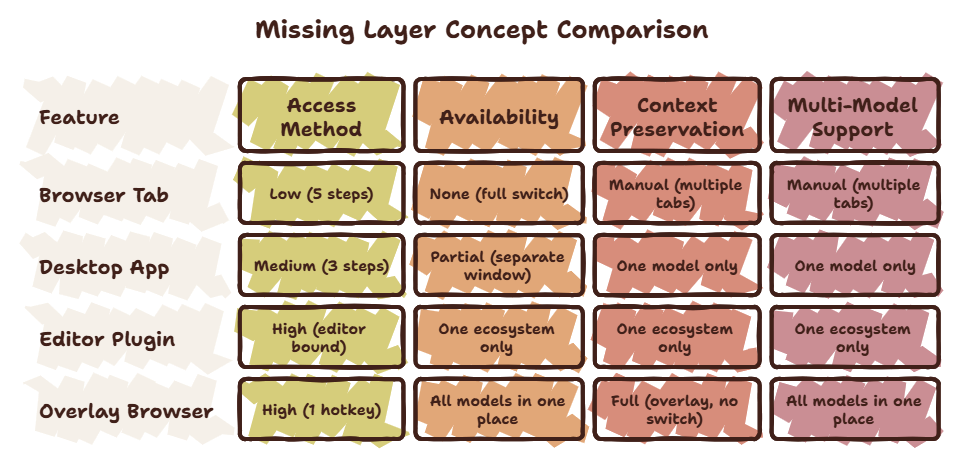
What Exists Today
The closest thing to the missing layer is an overlay browser.
An overlay browser like SiteQuest is a browser that does not take over your screen. It floats over your current workspace. You summon it with a hotkey. You use any web-based AI tool. You dismiss it. Your workspace never changes.
This solves all three requirements:
- Availability: Shift-Space. One keystroke. No navigation.
- Context preservation: The overlay appears over your current workspace. Your primary application stays visible. Your brain never context-switches.
- Multi-model support: Any web-based AI tool works inside the overlay. ChatGPT, Claude, Gemini, Perplexity — all one hotkey away.
Why This Matters More Than Model Choice
The difference between GPT-4o and Claude 4 is small. A few percentage points on benchmarks. The difference between zero friction access and browser-tab access is massive. It determines whether you actually use AI in your workflow or just think about using it.
Most people over-optimize model selection and under-optimize access method. They spend hours comparing benchmark scores and zero minutes improving how they reach the tool.
The missing layer is not a better model. It is a better access method.
The SiteQuest Perspective
SiteQuest is designed to be the missing layer. A lightweight overlay browser that makes every AI tool one hotkey away. No tabs. No switching. No context loss. The missing layer is finally here.
For a practical setup, read our guide on how to combine AI tools without tabs taking over.
Final Thought
The best AI model is the one you actually use. And you will use the one that is easiest to reach.